
Why AI in CBS Customer Service Often Automates Frustration

Updated: Jan 22

3 ways this issue shows up, depending on your role
CEO's Point of View
Your Net Promoter Score (NPS) is slipping. Call volumes are up. Costs aren’t going down, despite “AI investments.”
You didn’t buy AI to answer faster. You bought it to fix the experience. It didn’t.
CX Leader's Point of View
Your customer service representitives are exhausted. Customers repeat themselves. Every escalation feels avoidable and yet inevitable. The tech responds quickly. The outcomes don’t.
Risk / Compliance Point of View
You’re watching AI pilots closely. Too closely. Not because you hate innovation but because you don’t trust what the system might say, do, or expose. And you’re right not to.
The uncomfortable truth
Most CBS companies don’t have a customer service wait-time problem. They have a resolution credibility problem.
In customer service, time is rarely the real problem. Customers aren’t frustrated because they waited 12 minutes; they’re frustrated because they don’t trust that the system understands them, they don’t know what will happen next, they don’t believe the issue will actually be resolved, and/or they fully expect they’ll have to call back anyway. Most AI deployments in customer service optimize for speed and, in doing so, accidentally automate confusion.
What most CBS companies do (and why it backfires)

Standard strategies look sensible on paper. CBS companies introduce chatbots or voice bots to deflect calls, capture the customer’s issue in natural language, create a ticket, and promise a follow-up. The flow is clean. The dashboards improve. Leadership sees reduced handle time and assumes progress is being made.
But reality is messier - The context is often missing. Customer identity is unclear. Product ownership isn’t obvious. Consent rules vary by channel and aren’t consistently enforced. Tickets get created, but without enough signal to drive real resolution. Customer Service Representativess still have to step in, reconstruct the situation, and untangle what the automation couldn’t understand in the first place.
So the customers still experience frustration:
“You answered faster… but nothing actually changed.”
Legal and Risk see a different set of problems entirely. They see AI responses that aren’t fully controlled, disclosures that vary depending on how a question is phrased, and the ever-present risk of hallucinated answers in regulated conversations. Most concerning, there’s often no clear audit trail explaining why an AI said what it said or took a particular action. When trust breaks at this level, AI initiatives don’t get refined. They get slowed down or shut down entirely.
The real problem no one wants to name
AI isn’t failing in customer service because it’s inaccurate. It’s failing because it isn’t trusted. That lack of trust spans every stakeholder that matters: customers don’t trust it with their issues, agents don’t trust it to set them up for success, compliance doesn’t trust it to stay within guardrails, and leadership doesn’t trust it to operate safely at scale. And untrusted systems never earn autonomy asthey get throttled, monitored, and quietly sidelined.
What actually works: the CBS-grade pattern
In regulated environments, AI can’t just talk. It has to act responsibly, with context, control, and clarity. The winning pattern starts with the AI understanding who is calling, not just what they are saying. That means real customer context identity, products owned, relationship history, eligibility, and consent boundaries not just a transcript of the conversation.
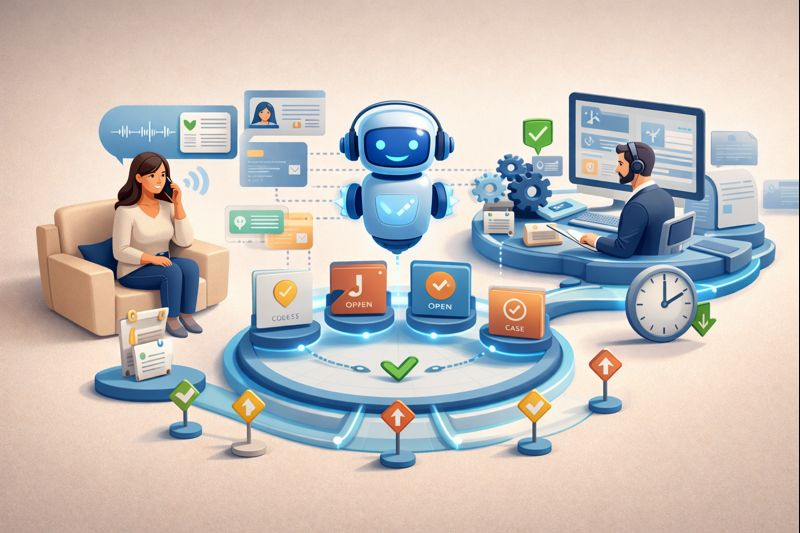
From there, the AI must be able to take controlled action. Not vague promises or polite deflection, but concrete steps: creating a case with real signal, routing it correctly the first time, triggering downstream workflows, and setting clear expectations. Action builds credibility when it’s precise and consistent.
Just as important is how the AI communicates. Customers don’t want to hear “we’ll get back to you.” They want to know what’s happening now, what happens next, when they’ll hear back, and what they no longer need to do. Confidence comes from clarity, not optimism.
In this model, humans step in where judgment truly matters, not where automation failed. AI handles intake, clarity and momentum. Humans handle nuance, exceptions, and trust repair. That’s more than deflection; that’s resolution by design.
Why most CBS organizations can’t do this (yet)
The root cause is structural. Many CBS organizations build AI on shaky foundations: fragmented customer identity across systems, consent that is captured but rarely enforced downstream, and Salesforce treated primarily as a ticketing tool instead of a decision platform. At the same time, AI operates without strong ties to brand voice, policy, and operational guardrails. The result is automation that moves quickly, but never earns lasting trust.
The Truffle truth
If your AI can’t explain why it took an action, it shouldn’t take one.
Where Agentforce for Service fits quietly, but powerfully
This is where platforms like Agentforce for Service create real leverage. Not as generic AI chat, but as brand-trained, policy-aware service agents. When implemented correctly, AI agents interpret customer intent in full context, operate within defined business and compliance rules, and create and manage cases with clarity and precision. They support human agents by handling intake and orchestration, while maintaining brand voice, explainability, and auditability across every interaction.
What success actually looks like
Forget vanity metrics like deflection rate. CBS leaders focus on outcomes that signal real trust and performance: time to confident resolution, reduction in repeat calls, first-contact clarity, agent productivity without burnout, and AI interactions that are audit-safe by design.
Speed matters but trust compounds.
Why Truffle gets called in when this matters
At Truffle, we don’t deploy AI to make call centers quieter. We deploy AI to make outcomes defensible.
We’ve implemented AI-powered service and voice agents across environments where:
Compliance is non-negotiable
Customer trust is fragile
Salesforce is already in play
“Move fast” isn’t an option but move right is
Our focus isn’t automation for automation’s sake. It’s resolution without chaos.
The real takeaway
AI won’t save your customer service if your foundation is broken. But when identity, consent, and action are designed together - AI finally earns trust.

That’s when customers stop waiting. And start believing again. If you’re exploring AI agents or voice automation in a regulated environment and want to avoid automating frustration - connect with us, and we can show you how to do it.
We’ve done this before.Quietly. Safely. At scale.
→ Let’s compare notes
Email us today: hello@trufflecorp.com
Visit our website: https://www.trufflecorp.com/contact-us
Important links:


Comments